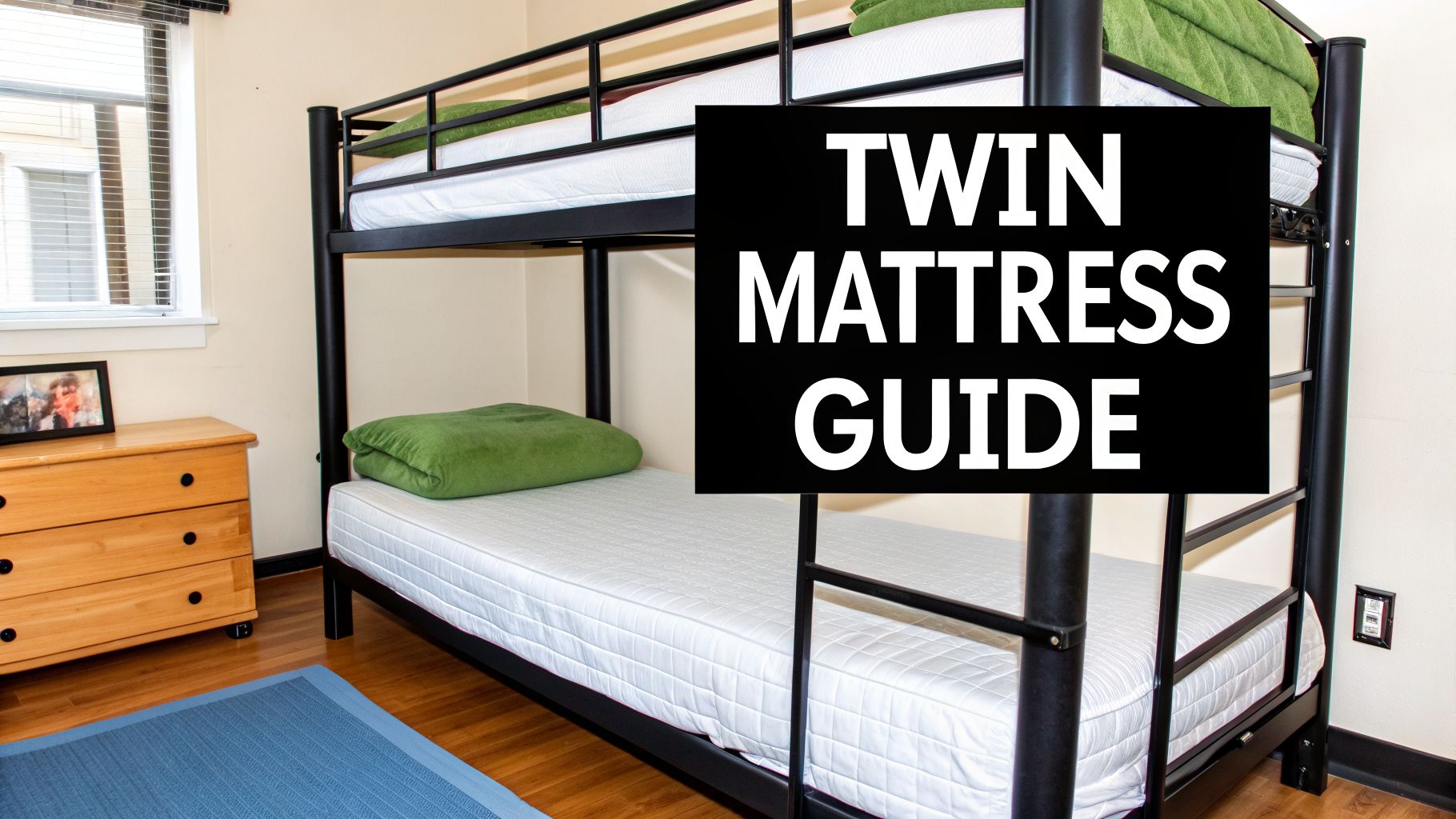
For most bunk beds, the standard mattress size is a Twin measuring approximately 38 inches wide by 75 inches long. However, width and length are only part of the decision. Mattress thickness is especially important on the top bunk because a mattress that is too tall can reduce the effective height of the guardrail.
That detail matters in any home, and it deserves extra attention in a vacation rental. Guests may be unfamiliar with the room, the furniture and the property’s sleeping arrangements. Choosing the correct mattress size and checking the guardrail clearance helps create a bunk room that is comfortable, practical and thoughtfully equipped.
Quick guide to bunk bed mattress sizes
Twin mattresses are the most common choice for bunk beds, but Twin XL can be a better option when teens and adults will use the bunks. Here is a basic comparison:
| Mattress size | Approximate dimensions | Typical top-bunk thickness | Typical bottom-bunk thickness |
|---|---|---|---|
| Twin | 38" x 75" | 6"–8" | 8"–10" |
| Twin XL | 38" x 80" | 6"–8" | 8"–12" |
These are general planning ranges, not a substitute for measuring the specific bunk bed. The frame, guardrail height, mattress support and manufacturer’s instructions should always be considered together.
Why mattress thickness matters on the top bunk
A thick mattress can make a guardrail less effective. The top surface of the mattress should remain at least five inches below the top edge of the guardrail, commonly referred to as the “5-inch rule.” This clearance helps maintain a substantial barrier between the sleeper and the edge of the bunk.
To estimate the maximum mattress thickness, measure from the mattress support surface to the top of the guardrail, then subtract five inches.
Example: If the distance from the slats to the top of the guardrail is 13 inches, the mattress should be no more than 8 inches thick: 13 inches minus 5 inches equals 8 inches.
Always follow the instructions supplied with the bunk bed and mattress. If you are unsure whether a mattress is appropriate, contact the bed manufacturer before using it.
Twin or Twin XL: which is better?
A standard Twin is often the easiest fit, particularly when replacing mattresses in an existing bunk bed. A Twin XL is five inches longer, measuring approximately 38 by 80 inches. That additional length can make a meaningful difference for taller teenagers and adults.
Twin XL bunks can be a smart choice for Gulf Coast vacation homes, beach rentals and family properties where several adults may share a room. Longer mattresses help the bunk room function as genuine guest sleeping space rather than a setup intended only for children.
There is an important planning consideration: a Twin XL will not fit a standard Twin frame. The bunk bed, room layout and mattress support must all be designed for the extra length.
How to measure a bunk bed for the right mattress
A mattress that is too large can buckle or distort. One that is too small can leave unwanted gaps between the mattress and the frame. Before ordering a replacement or planning a new bunk room, measure the actual interior of the bed.
- Measure the interior length. Place the tape measure on the mattress support and measure from the inside of the headboard to the inside of the footboard.
- Measure the interior width. Measure between the inside faces of the two side rails.
- Check the support surface. Note whether the bed uses closely spaced slats, a platform or another support system.
- Measure guardrail clearance. Determine how much space exists from the mattress support to the top of the rail.
The mattress should fit closely without being forced into the frame. The acceptable gap depends on the bed’s design and applicable safety guidance, so do not assume that a visibly large space is acceptable.
Why custom-built bunks help with mattress planning
Off-the-shelf bunk beds are generally designed around one standard set of dimensions. That can limit your choices when a room needs Twin XL mattresses, taller guardrails, additional sleeping levels or a layout tailored to an unusual wall or ceiling.
A custom bunk bed begins with the room, the intended users and the mattress choice. The design can account for:
- Twin, Twin XL or other requested mattress dimensions
- Guardrail height and mattress thickness
- Headroom between bunks and at the ceiling
- Triple-bunk, quad-bunk or wall-to-wall configurations
- Narrow rooms, angled ceilings and other challenging spaces
- Heavy use in a vacation rental or busy family home
- Storage, ladder placement and access to each sleeping level
Florida Bunk Beds builds heavy-duty bunk bed systems for coastal homes, vacation rentals and family spaces from the Florida Panhandle and Florida Gulf Coast through Key West, as well as Orange Beach, Alabama. The goal is a durable, polished design that supports the way your property is actually used.
Selecting a mattress for a vacation rental
Mattress quality affects both guest comfort and the long-term maintenance of a rental property. A mattress for a high-use bunk room should provide consistent support, resist premature sagging and be practical to replace or clean when needed.
High-density foam
Foam mattresses can provide even support and reduce motion transfer between sleepers. A firm or medium-firm model is often a practical choice for bunk beds, provided its thickness is compatible with the guardrail.
Hybrid mattresses
Hybrid designs combine foam comfort layers with coil support. They may be appropriate for adult guests, but their overall height can vary significantly, so measure the finished mattress rather than relying only on the listed size category.
Innerspring mattresses
A well-constructed innerspring mattress can also work in a bunk bed. Pay attention to its height, support and motion characteristics, especially when two bunks share a room.
Mattresses in vacation rentals may experience more frequent use than those in a private bedroom. Pairing a suitable mattress with a robust frame and properly spaced support slats can help create a more dependable sleep setup.
Designing a more comfortable coastal bunk room
In Florida vacation properties, bunk rooms often need to accommodate groups without making the space feel improvised. A custom configuration can make better use of a small room while giving guests practical access, appropriate guardrails and a mattress size suited to the intended sleepers.
Twin bunks may be ideal for children and compact rooms. Twin XL bunks are worth considering when the room is intended for adults, teenagers or mixed-age groups. The right choice depends on the available footprint, ceiling height, desired capacity and the way the property is marketed to guests.
Frequently asked questions
Can I use a regular Twin mattress on a bunk bed?
Usually, a standard Twin mattress measuring about 38 by 75 inches is the expected size. Confirm the bunk’s interior dimensions first, then verify the mattress thickness and top-rail clearance. A Twin that fits the length and width may still be unsuitable if it is too tall for the top bunk.
What thickness is best for a top bunk?
A 6- to 8-inch mattress is a common range for many top bunks. The correct maximum depends on the distance from the mattress support to the top of the guardrail. Do not use a thicker mattress unless the bunk was designed and approved for that thickness.
Does a bunk bed need a bunkie board?
That depends on the support system. Closely spaced, properly designed slats may support the mattress without a bunkie board. If the slats are widely spaced or the mattress manufacturer requires a solid foundation, an appropriate bunkie board or platform may be necessary. Check both sets of instructions before adding one, since it can also raise the mattress and reduce guardrail clearance.
Is Twin XL a good choice for a vacation-rental bunk room?
It can be an excellent choice when adults or taller teens will use the bunks. The extra five inches of length improves comfort, but the frame and room must be built around the 80-inch mattress. A standard Twin bunk cannot simply be converted by buying a longer mattress.
Can a custom bunk bed be designed for a small or unusual room?
Custom planning can address narrow rooms, limited headroom, multiple bunk levels, storage needs and other layout concerns. The design should be developed around the room dimensions, the intended mattress and the safety requirements of the bunk configuration.
Plan your Florida bunk room
Start by browsing bunk bed designs, then call or text Carson or Andy at 850-361-9988. We can discuss your room, preferred mattress size, guest needs and overall bunk-room goals before preparing a quote.