In a busy Florida vacation rental, a bunk room can serve a steady stream of children, teenagers and adults. After repeated bookings, small construction weaknesses become easier to notice: mattresses begin to feel uneven, slats creak, hardware shifts and the sleep surface no longer feels as solid as it did when the room was new.
Those problems are not always caused by the mattress itself. Often, they begin with the mattress support system beneath it.
Whether you are furnishing a beach house in the Florida Panhandle, a Gulf Coast condo, a family rental near Orange Beach or a property farther south toward Key West, the foundation of the bunk deserves as much attention as the visible design. Slat spacing, platform construction, guardrail clearance, mattress thickness and ventilation all work together.
Why mattress support matters in a custom bunk room
Mattress support is a hidden part of the design, but it affects three things owners and guests notice quickly:
- Safety: The support system helps determine the final mattress height and the amount of guardrail remaining above the mattress.
- Durability: A rigid, well-fastened foundation helps limit sagging, movement, premature mattress wear and repeated service issues.
- Comfort: Even support creates a more stable and consistent sleeping surface.
For upper bunks, the mattress and support deck must be considered together. Consumer Product Safety Commission guidance addresses guardrail height, mattress fit, labeling and warnings for bunk beds. In the recommended configuration, the upper edge of the guardrail should extend at least 5 inches above the top surface of the thickest recommended mattress. Final design decisions should be checked against applicable requirements and the manufacturer’s instructions.
A mattress that is too thick can reduce the effective guardrail height. A mattress that is too thin may create an uncomfortable sleep surface. The support, mattress profile and bunk layout should be selected as one system rather than as separate purchases.
Why Florida rental properties put extra demands on bunk beds
Vacation-rental bunks are used differently from bunks in an occasional-use bedroom. Adults sit on the edges, children climb and bounce, guests move luggage around the room, and housekeeping teams repeatedly strip and remake the beds. With back-to-back reservations, those loads add up quickly.
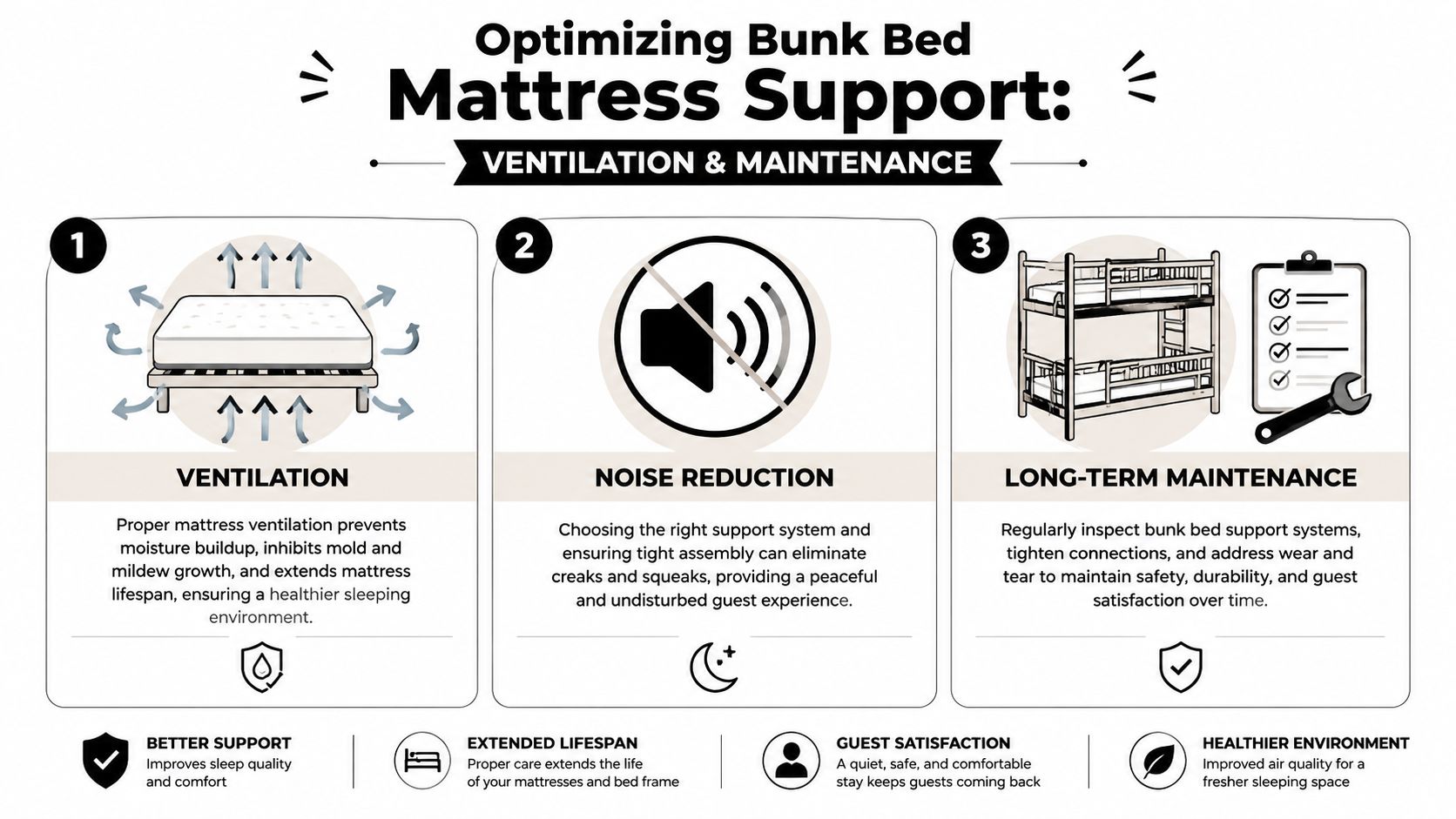
Coastal properties also require attention to humidity and airflow. A mattress placed over a poorly ventilated solid surface may retain moisture, especially in an enclosed bunk nook. Good support is not only about strength; it is also about keeping the mattress environment practical to maintain.
For that reason, a heavy-duty-looking frame is not enough by itself. The rails, cleats, slats, platform, fasteners and guardrails all need to work together for the intended users and room conditions.
Common bunk bed mattress support options
Several support approaches can work in a custom bunk room. The right choice depends on the mattress, available guardrail clearance, bunk width, expected use and ventilation needs.
Wood slats
Slats are a common choice because they can provide airflow while keeping the mattress relatively low. Their performance depends heavily on the details: material thickness, spacing, span, fastening and whether wider bunks receive center reinforcement.
Closely spaced, substantial slats can work well with many innerspring, hybrid and foam mattresses. Thin slats, wide gaps or unsupported spans can contribute to flex, noise and uneven mattress wear. Mattress manufacturers should be consulted for foundation requirements and warranty spacing.
Bunkie boards
A bunkie board creates a flatter support surface without the height of a traditional box spring. It can be useful when a mattress needs more continuous support or when the bunk has limited clearance.
However, a bunkie board does not correct a flexible frame or poorly supported slats. It should be installed as part of a sound structure, not used to hide one that is underbuilt.
Metal grid systems
Metal grids can provide a rigid support deck for hard-use settings. They may be practical in some rental applications, although connection quality matters. Poorly fitted or inadequately secured components can transmit vibration or develop rattles.
For built-in or furniture-style bunk rooms, the appearance and detailing of a metal system may also need to be considered alongside the overall millwork design.
Solid or ventilated platforms
A platform can provide broad, consistent support and may suit some foam mattresses particularly well. In Florida’s humid coastal environment, the platform should be detailed with airflow and moisture management in mind. A ventilated panel or carefully designed support surface is different from simply placing a sheet of plywood into a frame.
Why box springs are usually a poor fit for bunks
Traditional box springs add height that most bunk beds cannot spare. On an upper bunk, that extra height can reduce guardrail exposure and leave less room for changes in mattress selection later. A low-profile support system with stable, direct contact beneath the mattress is generally more practical for bunk construction.
Match the support to the mattress
Mattresses respond differently to the foundation below them:
| Mattress type | Support considerations | Problem to avoid |
|---|---|---|
| Memory foam | Solid, ventilated support, a bunkie board or closely spaced slats | Foam settling into wide gaps or flexing excessively |
| Hybrid | Rigid, level support with appropriate slat spacing | Motion and noise from a flexible base |
| Innerspring | Properly spaced slats or a rigid platform | Uneven support across the span |
Mattress thickness matters as well as mattress type. Common bunk mattresses are often twin, approximately 38 by 75 inches, or twin XL, approximately 38 by 80 inches. Many bunk applications use a profile below 10 inches, but the correct thickness depends on the specific bed, guardrail design, support system and user’s needs. The thickest recommended mattress should be established before the bunk is finalized.
What durable support looks like in a rental bunk room
Long-term performance comes from several construction decisions working together:
- Appropriate slat spacing: The mattress should not dip between supports.
- Substantial support material: Components should be sized for the span and expected loads.
- Strong edge bearing: Guests frequently sit on the side of the lower bunk or use the edge while climbing.
- Center support where needed: Wider bunk platforms may require reinforcement through the middle.
- Positive fastening: Slats, cleats and rails should remain positioned during repeated use.
- Correct hardware and connections: A strong deck cannot compensate for weak rails, loose joints or undersized fasteners.
These details are especially relevant for adult bunk beds, triple bunk beds, quad bunk beds and built-in bunk rooms intended to increase sleeping capacity in a vacation property.
Ventilation, noise and maintenance
Coastal air and humid indoor conditions make airflow worth planning from the beginning. Slats generally allow more air movement than a fully enclosed panel. A ventilated bunkie board can provide a flatter surface while preserving some airflow. A solid platform may also work, but it needs appropriate detailing for the room’s moisture conditions.
Noise usually develops at connection points: loose slats, shifting boards, friction between components or hardware that has begun to move. A properly fitted and secured support system can help reduce those distractions, although every bunk room should be inspected periodically.
Owners and property managers can include a few simple checks during routine turnover or maintenance:
- Press lightly on mattress corners and edges to check for unusual movement.
- Look for sagging or recurring soft spots.
- Inspect visible fasteners, rails and ladder connections.
- Lift mattresses occasionally to check for trapped moisture, rubbing or shifted components.
- Confirm that replacement mattresses match the original size and thickness requirements.
Choosing support for your Florida bunk room
The best support system depends on the actual property and its users. A bunk room for young children has different requirements from one expected to accommodate adults. A compact condo bunk nook may have tighter height limits than a large custom room in a Gulf Coast vacation home. A humid beach property may need different airflow planning from a seasonal inland home.
Before selecting a design, consider:
- Who will use the bunks and how frequently?
- Will adults use the lower or upper bunks?
- What mattress type and final thickness will be used?
- Does the layout require twin, twin XL or another bunk size?
- How much guardrail will remain above the thickest recommended mattress?
- How will the support deck handle airflow and routine cleaning?
- Does a wider bunk require center reinforcement?
Frequently asked questions
What is the best support for a bunk bed mattress?
There is no single support system for every bunk. Closely spaced slats, a bunkie board or a ventilated platform may all be appropriate when correctly matched to the mattress, frame and guardrail height.
Can I use a regular box spring on a bunk bed?
Box springs are generally not a good choice because they add height and may reduce the guardrail clearance on the upper bunk. A low-profile bunk support system is usually more suitable.
Are solid platforms suitable for Florida vacation rentals?
They can be, particularly when a mattress needs broad support. In humid or coastal rooms, the platform should be designed with appropriate ventilation and moisture considerations rather than treated as an enclosed surface.
How thick should a bunk mattress be?
The correct thickness depends on the bunk’s guardrails, support system, mattress construction and intended users. Confirm the maximum recommended mattress height for the specific design before ordering a replacement.
Can you help plan support for a custom bunk room?
Yes. When you browse designs, be ready to discuss the room dimensions, desired sleeping capacity, mattress plan, expected users, coastal location and whether the bunks will be freestanding or built-in. Carson or Andy can help you identify the next steps and prepare a quote.
Plan the foundation before the finishes
A successful vacation-rental bunk room is more than a clever layout or attractive finish. It should remain stable, comfortable and practical after repeated bookings. If you are planning bunk beds for a Florida beach house, Gulf Coast rental, Panhandle property or family home, review the support system at the same time as the frame, mattress and guardrails.
Browse the available designs, then call or text Carson or Andy at 850-361-9988 to discuss your room and request a quote. Include your location, preferred layout, mattress plans and any questions about support, clearance or ventilation.