Guests often arrive at a beach rental after a long drive, with luggage in hand and children ready for bed. If the first person turns on one bright ceiling fixture, the entire bunk room wakes up at once. A child may want to read, another guest may need to find the ladder, and someone else may already be trying to sleep.
That is why lighting deserves attention when planning bunk beds for vacation rentals. It is not simply a decorative feature. Proper lighting helps guests move through an unfamiliar room, use their individual sleeping space, and settle in without disturbing everyone else.
For owners furnishing Airbnb properties, beach houses, family retreats, condo rentals, and coastal homes from Orange Beach through the Florida Panhandle, the Florida Gulf Coast, and down to Key West, a well-planned bunk room can add capacity without feeling like an afterthought. Individual lighting is an important part of making that room work.
Why One Ceiling Light Is Not Enough
A ceiling fixture may illuminate the room, but it does not serve each bunk particularly well. Guests use a shared bunk room at different times and for different reasons. One person may be unpacking while another is reading, climbing to a top bunk, or trying to sleep.
Layered lighting gives the room more flexibility:
- Reading light near the pillow: Allows one guest to read or get organized without lighting the entire room.
- Soft guidance light: Makes nighttime movement less disruptive.
- Ladder and stair visibility: Helps guests identify access points in an unfamiliar layout.
- Individual control: Gives each sleeper a small area of privacy and autonomy.
That last point is easy to underestimate. A bunk can feel like a real sleeping berth when it has its own reachable light, rather than just being one of several mattresses beneath a bright overhead fixture. This is especially valuable in triple bunk beds, quad bunk beds, and adult bunk rooms shared by multiple families.
How Lighting Affects the Rental Experience
It supports safer nighttime movement
Top bunks, ladders, stairs, and compact floor plans all require clear visibility. Vacation-rental guests do not know the room as well as a family using a primary home. They may be tired, carrying bags, or walking through the room in the middle of the night.
A useful lighting plan should make ladder rungs, stair treads, bunk openings, and nearby floor transitions easy to locate. It should also avoid creating a harsh contrast between a bright room and a dark access area.
It gives guests more control
Shared sleeping works better when each guest can control their own immediate space. A dedicated light lets one person read while another sleeps. Parents can check on a child without switching on the main fixture, and adults in larger bunk rooms can use their beds without disturbing the room.
A practical rule is simple: if every bunk has a pillow, every bunk should have a reachable light source.
It reinforces the quality of the room
Listing photos need to communicate that a bunk room was designed for real use. Dark recesses, dangling cords, and mismatched clip-on fixtures can make a room feel temporary. Warm, controlled lighting helps show the structure, depth, and intended function of the bunks.
Guests also remember small conveniences: a place to read, a switch they can find, and enough light to locate a phone or water bottle. These details often communicate care more effectively than an oversized decorative feature.
Common Bunk Bed Lighting Options
The best fixture depends on the layout, the age of the guests, the expected turnover, and whether the lighting is being designed into custom bunk beds or added to an existing room.
| Fixture type | Good use | Important consideration |
|---|---|---|
| Low-profile LED strips | Under rails, beneath bunks, or behind trim | Use a channel or protected recess instead of relying on exposed adhesive. |
| Puck lights | Undersides of upper bunks and deeper alcoves | Position carefully to prevent glare. |
| Wall sconces | Side walls beside lower bunks or aisles | Keep them out of luggage and shoulder paths. |
| Gooseneck reading lights | Individual reading areas, especially adult bunks | Moving parts and mounting hardware need to withstand repeated use. |
LED lighting for coastal rental use
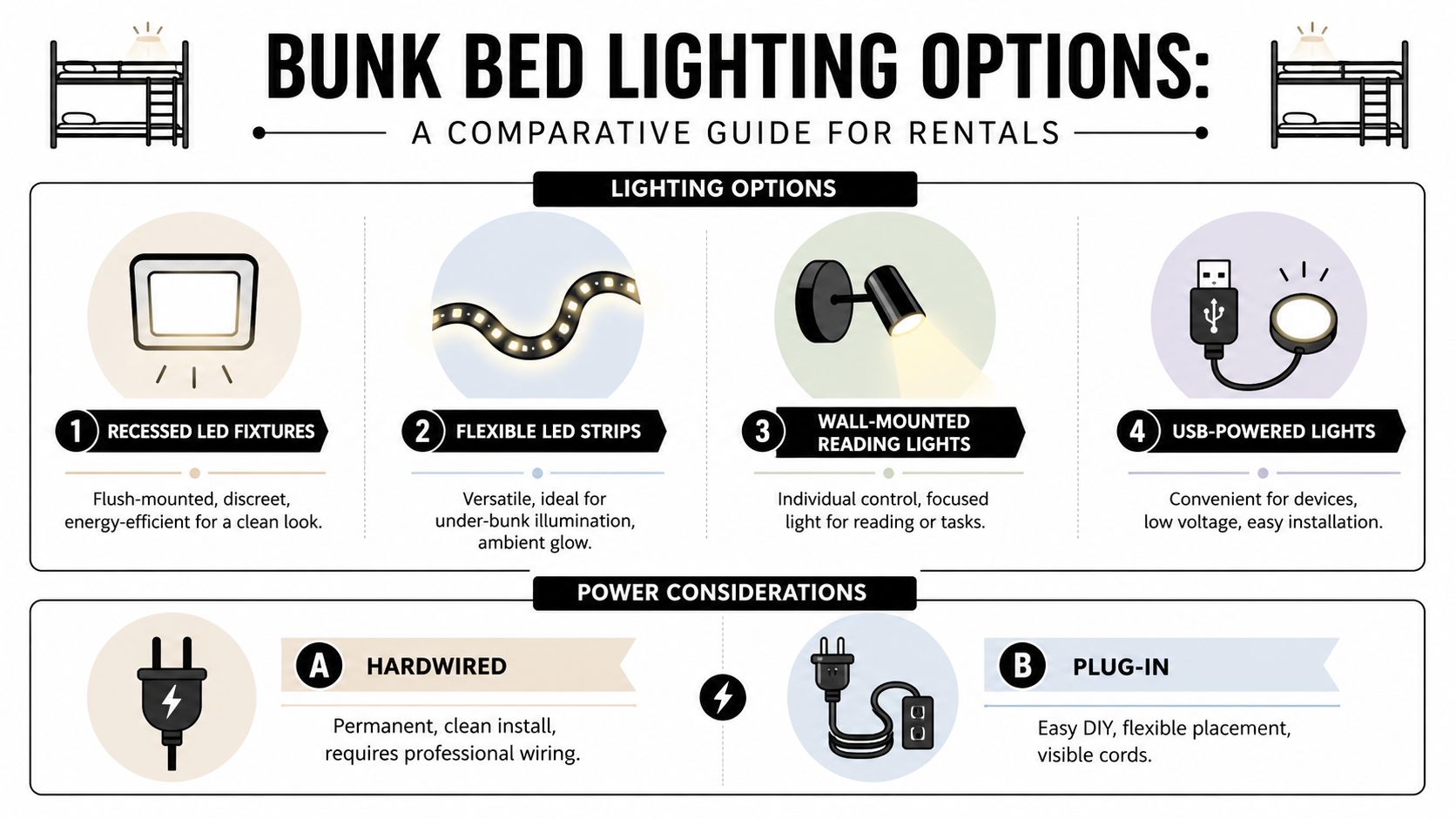
Low-voltage LED systems are commonly suited to close-proximity bunk applications because they produce relatively little heat and can be integrated into the bed structure. For Florida and Gulf Coast properties, the fixture finish and installation should also be practical for a humid, high-use environment and easy for housekeeping to wipe down.
LED strips can provide a subtle under-bunk or path glow. Puck lights offer more focused illumination. Sconces and adjustable reading lights can work well when the room has enough wall clearance. The right answer is usually the fixture that is simple to operate, securely mounted, and easy to maintain—not necessarily the most elaborate option.
Power and Control Choices
- Hardwired: A clean option for new construction, remodels, and integrated custom bunk beds. It avoids dangling cords when planned properly.
- Plug-in: Useful in an already finished room, provided cords have a protected and orderly route.
- USB-powered: Can combine personal lighting and device charging when incorporated into the overall design.
- Battery-powered: Easy to add but more demanding to maintain. Dead batteries can become a recurring housekeeping issue.
Individual switches are one of the most useful upgrades. Dimmers may also help a room serve different age groups and uses, from children settling down at night to adults reading in a queen-over-queen bunk.
Placement: Put the Light Where Guests Actually Use It
A fixture can be attractive in a drawing and still be inconvenient once someone is lying down. Lighting should be planned around the sleeper’s reach, the ladder entry, the direction of movement, and the location of luggage and cleaning activity.
- Place reading lights near the head area, within reach from the pillow.
- Use soft illumination near ladders, stairs, and floor transitions.
- For middle bunks in a triple arrangement, direct light down and forward rather than across another sleeper’s face.
- Keep fixture bodies shallow in hallway bunks and narrow alcoves.
- Use consistent placement in quad bunk rooms so every guest receives a comparable experience.
Avoid placing lights directly at eye level, too far from the pillow, or solely for visual symmetry. If a guest must sit up, lean out over a rail, or search behind the bunk to find the switch, the placement needs more thought.
Mounting and Durability in High-Turnover Properties
Vacation-rental lighting is bumped by luggage, handled by guests, and worked around during cleaning. Recessed or flush mounting generally creates a more protected result than a fixture that projects into a traffic path. LED channels help keep strip lighting straight and shield it from routine contact.
Wiring should be fully managed inside protected routes or enclosed portions of the structure. Cords should not dangle behind a ladder, cross an opening, or remain accessible where they can snag or be pulled.
Adhesive-only strip installations, loose clip-on fixtures, exposed bulbs, fragile shades, and bulky wall lights in narrow walkways can create unnecessary maintenance problems. Rental durability comes from secure hardware, protected wiring, straightforward controls, and fixtures that do not require guests to handle them delicately.
Safety Considerations
Bunk bed lighting should be planned with the same care as rails, ladders, guard areas, and clearances. In the United States, the federal bunk-bed standard is addressed in 16 CFR Part 1513, administered through the U.S. Consumer Product Safety Commission. Lighting added to the bed structure should not create new heat, snagging, contact, or entrapment concerns.
In practical terms, owners and designers should look for:
- Low-heat fixtures suitable for close use.
- Secure mounting that will not rotate, loosen, or detach during normal use.
- Protected wiring with no exposed or dangling cord paths.
- Placement that does not interfere with ladders, rails, guard areas, or clearances.
- Components that tolerate routine cleaning and repeated guest contact.
Lighting does not replace compliance review or proper installation. Final electrical work and code questions should be handled by the appropriate qualified professionals for the property.
Why Integrated Lighting Is Often the Cleanest Solution
Aftermarket fixtures can be useful, particularly in an existing room. However, integrated lighting usually produces a more finished result because the bed, trim, switch locations, wiring, and fixture placement are considered together.
This approach is especially useful for built-in-look bunk beds, custom bunk beds in compact coastal rooms, adult bunk beds, and heavy-duty bunk systems intended for regular rental turnover. The lighting can be positioned for the sleeper’s reach, concealed within the structure, and protected from luggage and cleaning equipment.
Integrated lighting also keeps the room visually calmer. Guests see a comfortable, purposeful bunk space rather than a collection of cords and add-on fixtures.
Frequently Asked Questions
Does every bunk need its own light?
For a shared vacation-rental bunk room, an individual reachable light is usually the most comfortable arrangement. It lets guests control their own space without disturbing others.
What type of light works best near a bunk?
Low-profile LED strips, recessed or protected puck lights, and securely mounted reading lights are common choices. The best option depends on the bunk dimensions, wall clearance, controls, and wiring plan.
Are battery lights a good choice for rentals?
They can be convenient for a retrofit, but batteries add an ongoing maintenance task. A securely integrated or hardwired low-voltage system may be more consistent for a frequently occupied property.
Can lighting be added to existing bunk beds?
Often, yes. The design should account for mounting, cord protection, access to power, ladder and rail clearances, and the condition of the existing structure. A built-in lighting plan is generally easier when the bunk design is being created or modified at the same time.
Should beach-house lighting use a particular finish?
Choose finishes and fixtures that are practical for the property’s humidity, cleaning routine, and guest traffic. The right selection depends on the specific room and installation rather than on a single universal finish.
Planning Bunk Bed Lighting for Your Property
- Review the room: Consider ceiling height, bunk configuration, ladder or stair access, wall locations, and existing power.
- Define guest use: Decide whether the room is primarily for children, adults, families, or mixed groups.
- Select the lighting layers: Plan individual reading lights, low ambient or path lighting, and any needed dimming or charging features.
- Coordinate the structure: Keep fixtures, wires, rails, ladders, clearances, and hardware working together.
- Choose a durable installation: Favor protected mounting and simple controls that housekeeping and guests can understand immediately.
Browse the available bunk bed designs on FloridaBunkBeds.com, then call or text Carson or Andy at 850-361-9988 to discuss your room and request a quote. We can help you think through the bunk configuration and lighting details before you commit to a design.