Guests arriving at a Florida vacation rental rarely travel light. Beach bags, towels, sandals, chargers, extra pillows, children’s belongings, and luggage can take over a bunk room quickly. Without a clear place to put those items, the floor becomes the storage system.
Under-bed storage drawers make use of space that would otherwise sit empty. In a busy rental from Orange Beach and the Florida Panhandle down the Gulf Coast to Key West, that added function can help keep walkways open, make turnovers easier, and give guests a more intuitive room to use.
This is particularly important for adult bunk rooms, family beach houses, and vacation properties with triple or quad bunk beds. The bed may sleep more guests, but the room also needs to accommodate everything those guests bring with them.
Why storage belongs in the bunk-room plan
A bunk room can look finished on installation day and still become difficult to manage after the first few stays. Loose plastic tubs move out of alignment, mismatched containers collect sand and dust, and bags are left beside ladders or along the walls. Housekeepers then have to move belongings and storage pieces just to clean the floor.
Integrated drawers address that problem without requiring another dresser, cabinet, or bench. They turn the space below the bed into useful storage while preserving the room’s walking area. When the drawers are designed with the bunk, they look like part of the furniture rather than an afterthought.
What guests commonly store
Most guests are not looking for a complicated organizing system. They need storage that is visible, easy to open, and large enough for everyday overflow, such as:
- Spare blankets, sheets, pillows, and towels
- Beach bags, swimsuits, and lightweight gear
- Suitcases, duffels, and packing cubes
- Children’s toys, stuffed animals, and extra clothing
- Board games and other family-room items
A useful rule is simple: if a guest must kneel down, reach deep into a dark opening, or fight with a sticking container, the storage is unlikely to be used consistently. Smooth access and a clear opening matter more than maximum depth.
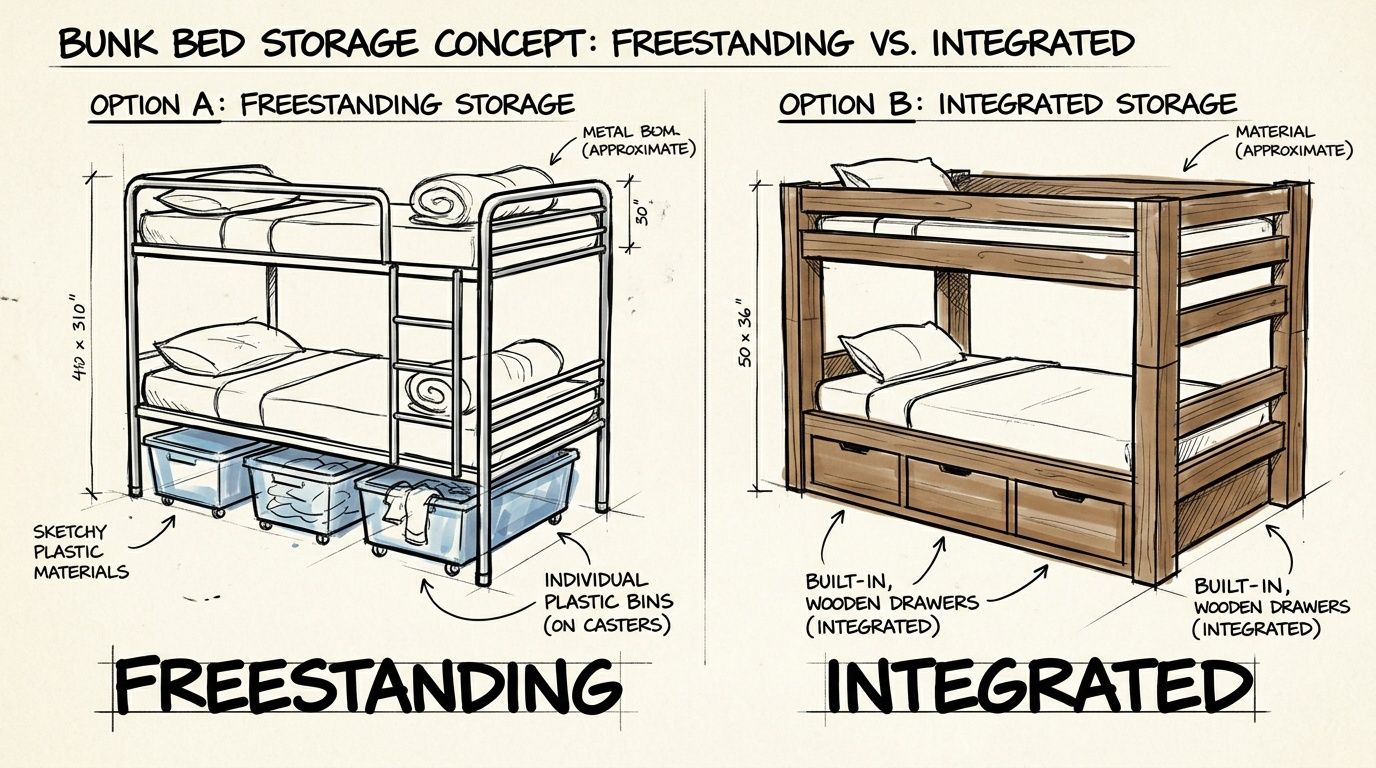
Freestanding bins or integrated drawers?
Freestanding plastic bins, rolling boxes, and retail drawers can be a reasonable short-term solution. They are quick to buy, easy to replace individually, and movable when a room’s layout changes. They may work well for light residential use or temporary storage.
In a rental bunk room, the drawbacks become more noticeable. Containers can shift when pulled from one corner, lids can separate, wheels can collect grit, and exposed edges can make a carefully designed room look unfinished. These issues are especially apparent with custom bunk beds, built-in bunk beds, and larger adult bunk configurations.
Integrated under-bed drawers are planned around the bed’s posts, supports, ladders, stairs, and trim. They can provide:
- A cleaner, furniture-like appearance
- More predictable alignment and access
- Better use of the available opening
- A storage solution coordinated with the room layout
Integrated storage requires accurate planning, but it is generally the more cohesive approach when the bunk room is being designed for continuing vacation-rental use.
Measure the opening—not just the mattress
A queen or twin mattress size does not tell you how much room is available underneath the bed. Posts, ladder locations, center supports, stairs, trundles, wall trim, and flooring can all reduce the usable opening.
Before a drawer is designed or ordered, verify:
- Floor-to-rail clearance: Measure from the finished floor to the lowest fixed obstruction.
- Clear width: Measure between posts, legs, ladders, and support members.
- Usable depth: Check how far a drawer can extend before meeting a cross support or wall.
- Pull-out space: Confirm that the aisle provides enough room to open the drawer comfortably.
- Floor and trim conditions: Account for flooring thickness, baseboards, transitions, and uneven areas.
Measure the finished room whenever possible. A drawer that fits the framed opening may bind after flooring, molding, bedding, or other finish details are added.
Plan around the bunk-room layout
Storage geometry becomes more complicated as the bunk design becomes more functional. A centered ladder may divide the opening. Additional supports in triple and quad bunk beds may limit drawer width. Storage stairs and pull-out trundles may require separate clearances. Thick comforters can also catch on a drawer face when the opening is tight.
The best drawer size is not automatically the largest one that will fit. It should open without interference, hold the items the room actually needs, and leave the traffic path comfortable for guests and cleaners. Shallower drawers may be the better choice in a narrow coastal rental, while a wider room may accommodate larger drawers for bedding and luggage.
Materials for coastal vacation-rental use
Florida rental furniture may encounter sand, humidity, damp towels, wet swimsuits, heavy luggage, and frequent cleaning. Drawers are also often pulled unevenly, overloaded, or closed with more force than they would be in a private bedroom. Light-duty construction can show wear quickly under those conditions.
When comparing storage options, pay attention to construction rather than finish alone:
- Solid, reinforced drawer bottoms that resist sagging
- Strong joinery that helps the box stay square
- Rigid drawer fronts that resist twisting
- Runners, wheels, or slides suited to the expected load
- Components that can be adjusted or serviced if needed
Thin plastic, particleboard, and light-duty veneered boxes may be adequate for occasional household storage, but they can be less suitable for a bunk room used repeatedly by changing groups. The storage should be selected with the same practical standard as the bunk frame, ladder, guardrails, and stairs.
Choosing how the drawers operate
There is no single operating system that suits every room. The choice depends on the drawer size, floor condition, expected contents, and how closely the storage is integrated into the bed.
- Casters or wheels: Straightforward and useful for larger boxes when the floor is reasonably flat. They can drift, collect grit, or feel rough on uneven surfaces.
- Metal slides: Provide guided movement and controlled extension when installed accurately. They require careful alignment and can become a maintenance point if overloaded or damaged.
- Wooden runners or integrated guides: Can suit a furniture-style or rustic bunk design, but they depend on accurate fit and a drawer box that remains square.
For a vacation rental, prioritize dependable operation under ordinary misuse. A drawer that works beautifully when empty may not perform the same way when loaded with towels, blankets, toys, and luggage.
Common planning mistakes
- Assuming mattress dimensions equal the under-bed opening
- Ignoring ladders, posts, stairs, trim, or trundles
- Choosing the deepest drawer without considering its loaded weight
- Using a storage box that is difficult to remove for cleaning
- Adding generic bins after the bunk design is already complete
- Failing to account for sand, moisture, bedding, and repeated turnover
Good storage planning starts before the bunk is built. It allows the frame, openings, hardware, drawer faces, and room circulation to work together.
Questions to ask before selecting under-bed drawers
- Do all bunk beds need storage drawers?
- No. They are most valuable when the room serves families or groups, has limited floor space, or needs dedicated storage for linens, towels, luggage, or guest belongings.
- Are integrated drawers better than plastic bins?
- For a permanent vacation-rental bunk room, integrated drawers usually provide a cleaner appearance and more predictable fit. Freestanding bins can still make sense as a temporary or flexible solution.
- How deep should a drawer be?
- Depth depends on the clear opening, the items being stored, the available pull-out space, and the drawer’s operating system. A slightly shallower drawer that opens easily may be more useful than an oversized drawer that binds when loaded.
- Can drawers be added to an existing bunk bed?
- Possibly, but the bed must be checked for clearance, supports, legs, ladder placement, floor conditions, and safe drawer travel. An existing frame may not have been designed to accommodate integrated storage.
- What should Florida owners consider?
- Plan for sand, humidity, damp beach items, frequent cleaning, heavy bedding, and guests who may not handle the furniture gently. Those conditions make fit, materials, and serviceability especially important.
Planning a bunk room with storage
Start by deciding what the room needs to hold and how guests will move through it. Then review the finished dimensions, identify obstructions, and choose a drawer size and operating method that match the bunk design. Storage can be coordinated with custom bunk beds, adult bunk beds, rustic bunk beds, modern rustic designs, triple bunks, quad bunks, and built-in-look layouts.
Carson or Andy can discuss your room dimensions, intended use, and storage goals by call or text at 850-361-9988. Browse the available designs, then contact us to talk through the project and request a quote for your Florida Gulf Coast or Panhandle property.
\n