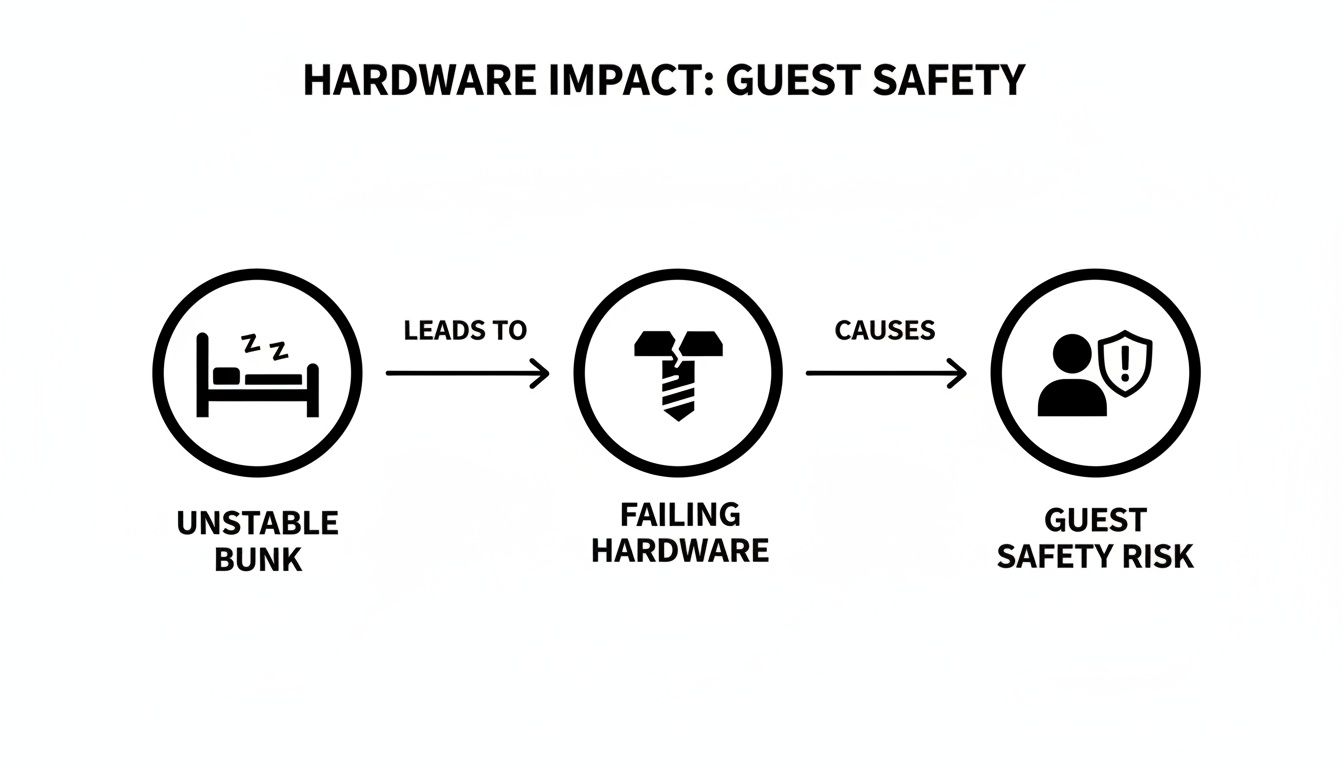
When a bunk room serves a busy vacation rental, the hidden components matter just as much as the visible design. A beautiful bunk bed can begin to squeak, loosen, or wobble when it is assembled with lightweight hardware that was never intended for frequent adult and family use.
From Orange Beach and the Florida Panhandle to the Gulf Coast and Key West, coastal rentals also bring humidity and salt air into the equation. Properly selected hardware, sound construction, accurate assembly, and routine inspection all contribute to a bunk room that remains comfortable and dependable for guests.
This guide explains the role of bunk bed hardware and what to consider when planning custom bunk beds for a Florida vacation home, beach house, or short-term rental.
Why hardware deserves attention
Owners naturally focus on the floor plan, finish, ladder style, and number of sleepers. Those choices are important, but the connections holding the frame together determine how the bed behaves over time.
A standard retail bunk bed may use small screws, lightweight brackets, or cam-lock connectors intended for occasional residential use. In a rental, the bed may be climbed, shifted, bumped, and used by both children and adults between one reservation and the next. Repeated movement places stress on every joint.
A squeak is often an early indication that a connection is moving. Continued movement can enlarge holes, loosen fasteners, and create an increasingly unstable frame. Stronger structural connections help limit that movement and support:
- Stability: Firm joints reduce sway in the frame, rails, and ladder.
- Quiet operation: Less movement at connection points means fewer creaks during the night.
- Guardrail security: Properly attached rails are better able to remain rigid during normal use.
- Long-term value: Durable construction can reduce premature repairs and replacement concerns.
Hardware does not replace good design or responsible use, but it is an essential part of turning lumber into a reliable sleeping structure.
What goes into a heavy-duty bunk bed frame?
The exact hardware package depends on the design, dimensions, wood selection, and installation conditions. In general, rental-grade construction may include several types of structural connectors rather than relying on one small fastener at each joint.
Structural through-bolts
A through-bolt passes through joined sections of wood and is secured with a washer and nut. This creates substantial clamping force and helps keep the joint aligned instead of relying solely on threads cut into the wood.
Lag bolts and structural screws
Where a through-bolt is not practical, appropriately sized lag bolts or structural screws can secure rails, supports, and other components to solid wood. Their length, diameter, and placement should be selected for the particular joint.
Barrel nuts and concealed connectors
Barrel nuts, also called cross-dowels, can provide a strong rail-to-post connection while keeping much of the hardware concealed. They are useful where a clean appearance and resistance to twisting are both priorities.
Reinforcement brackets
Heavy-gauge brackets may be used at selected high-stress areas. They can distribute force across a joint and add support where ladders, rails, stairs, or frame sections meet.
The right combination matters more than any single piece. Hardware must match the wood, joint, expected loading, and overall design.
Coastal conditions and corrosion resistance
Florida properties can expose furniture to humidity, condensation, and—particularly near the shoreline—salt-laden air. Hardware that is suitable for a dry indoor environment may not be the best choice for a beach rental or coastal home.
Corrosion-resistant finishes and suitable materials can help reduce rust and staining. They do not make hardware maintenance-free, and no finish eliminates the need to address leaks, standing moisture, or aggressive salt exposure. The location of the bunk room and the property’s maintenance conditions should be considered during design.
Standard hardware compared with structural hardware
| Area | Light-duty retail approach | Heavy-duty design approach |
|---|---|---|
| Main frame joints | Small screws or cam-lock fittings | Appropriately sized through-bolts, lag bolts, or structural connectors |
| Rail connections | Light stamped brackets | Stronger brackets or concealed connectors selected for the joint |
| Ladder attachment | Small screws, sometimes into end grain | Dedicated brackets and substantial fasteners suited to the ladder design |
| Material and finish | Basic hardware that may be more vulnerable to bending or corrosion | Stronger steel components with a finish appropriate to the environment |
| Service expectations | Occasional household use | Frequent guest turnover and repeated everyday use |
Load ratings, movement, and bunk bed safety
A published weight rating should never be viewed in isolation. A bunk bed experiences more than the static weight of a person lying still. Climbing a ladder, sitting down quickly, shifting position, or a child jumping onto a mattress creates dynamic force.
The frame, mattress support, guardrails, ladders, fasteners, and the way the bed is installed all contribute to performance. The weakest component limits the system. This is one reason a thick wood post cannot compensate for an undersized or poorly installed connector.
Guardrail dimensions, mattress thickness, openings, and clearances also deserve careful attention. The U.S. Consumer Product Safety Commission publishes applicable bunk-bed requirements and guidance, and designs should be evaluated against current requirements rather than relying on a general claim that a bed is “safe.” Installation instructions and intended-use limitations should be followed.
For a specific property, the room layout, ceiling height, wall conditions, access path, mattress selection, and intended sleepers should be discussed before construction begins.
Why precise assembly matters
Even quality components can perform poorly when they are installed incorrectly. A fastener that is too loose permits movement; one that is overtightened can crush wood fibers or damage the joint. Using the wrong screw or bolt can also split the wood or provide inadequate holding strength.
Professional assembly focuses on alignment, joint fit, fastener selection, tightening, and the final inspection. This is especially important for built-in, triple-bunk, and quad-bunk layouts, where several connected sleeping levels may place additional forces on the frame.
For vacation-rental owners, careful installation also makes future inspection easier. A properly assembled bed should be checked after installation and periodically thereafter, particularly after heavy occupancy, relocation, or any incident that may have affected the structure.
A practical inspection routine for rental owners
A brief inspection during a turnover or quieter maintenance period can help identify problems before the next reservation. Follow the builder’s instructions, and remove the bed from service if you find a serious defect.
- Check the main joints. Look at the connections where rails meet posts and confirm that fasteners have not loosened.
- Look for stress signs. Inspect the wood for cracks, crushed fibers, unusual gaps, discoloration, or fine dust near a connection.
- Test the ladder or stairs. They should attach firmly without noticeable movement, and each tread or rung should be secure.
- Examine the guardrails. Apply normal hand pressure and look for flexing, loose hardware, or changes in clearance.
- Watch for noise and sway. New squeaking or movement is a reason to investigate rather than simply tightening every fastener indiscriminately.
If a joint is damaged, a fastener is missing, or a component has bent or cracked, contact the builder or a qualified professional before the bunk is used again.
Hardware and the value of a vacation-rental bunk room
Low-cost furniture can become expensive when it produces maintenance calls, emergency repairs, guest complaints, or early replacement. A bunk room that feels solid and comfortable can be a practical way to make better use of a vacation property, but it needs to be designed for the way guests will actually use it.
That means considering more than sleeping capacity. The right configuration, durable materials, suitable coastal finishes, accessible ladders or stairs, guardrail design, and dependable connections all contribute to a better long-term ownership experience.
There is no universal hardware package for every room. A custom conversation allows the design to account for your available wall space, ceiling height, number of bunks, intended users, finish preferences, and location along the Florida coast.
Frequently asked questions
Can adult guests use custom bunk beds?
Some designs can be planned for adult use, but the appropriate configuration depends on the structure, dimensions, mattress support, hardware, and intended load. Discuss the expected users and use pattern before selecting a design.
Is stronger hardware enough to make any bunk bed safe?
No. Safety depends on the complete system, including design, materials, guardrails, mattress fit, clearances, assembly, installation, and responsible use. Hardware is a critical part, not the only part.
What hardware is best for a beach house?
Hardware should be selected for the joint and the environment. Corrosion-resistant materials or finishes may be appropriate in humid and coastal settings, but regular inspection and moisture control remain important.
Should I assemble a custom bunk bed myself?
Ask about the recommended installation method for the design. Complex or built-in beds require accurate alignment and correct fastening, so professional assembly may be the most practical choice for a rental property.
How do I begin planning a bunk room?
Browse the available designs, measure the room, note the ceiling height and access limitations, and call or text Carson or Andy at 850-361-9988. They can discuss your property and the next steps for a quote.
Plan your Florida bunk room
Browse designs for vacation rentals, beach houses, and family properties, then contact us to discuss dimensions, sleeping capacity, finish, installation, and the conditions at your location—from the Panhandle and Gulf Coast to the Keys.
Call or text Carson or Andy at 850-361-9988 to request a quote.