If you are furnishing a beach rental, coastal vacation home, or family retreat, a bunk bed’s weight capacity deserves more attention than a number on a product listing. Guests may sit on the lower bunk, climb to the upper level, place luggage on the frame, or use the room repeatedly throughout the year. Those conditions are very different from occasional use in a child’s bedroom.
For rental owners, bunk bed selection affects sleeping capacity, room layout, maintenance, and guest safety. The right system should be chosen around the people who will use it, the frequency of occupancy, and the construction of the bed—not simply its appearance or mattress size.
Why Weight Capacity Matters in a Vacation Rental
Vacation-rental bunks experience a wider range of use than most residential furniture. A lower bunk may become a seat while guests get ready, while the upper bunk is exposed to repeated climbing and concentrated pressure at the ladder and guardrail. In a busy Florida rental, those cycles can occur over and over between inspections.
Adult guests, children, and mixed-age groups also create different load patterns. Queen-over-queen bunks, triple bunk beds, and quad bunk beds are often installed specifically to accommodate larger groups, so the bed should be designed for the intended occupants rather than assumed to be children’s furniture.
- Mixed body types: Rental owners cannot plan around one consistent sleeper.
- More movement: Guests climb, sit on edges, shift position, and enter the bed in different ways.
- Frequent turnover: Repeated use can expose loose hardware or weak connections sooner.
- Shared sleeping areas: Lower bunks and larger layouts may be used by more than one guest.
Static Capacity and Real-World Use
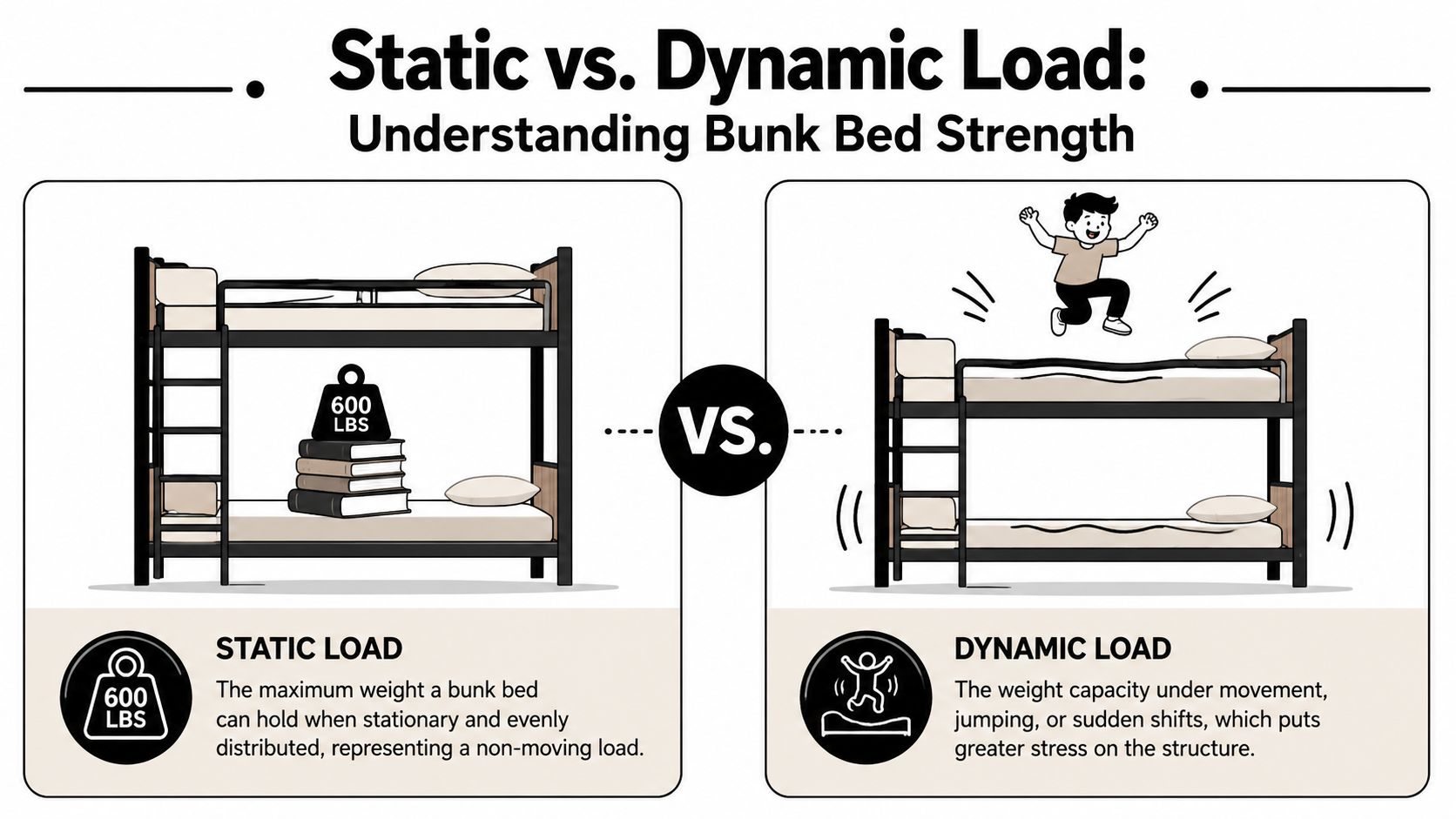
Many published weight ratings describe a static load: weight placed evenly on a bed while the occupant is relatively still. That information is useful for comparing products, but it does not describe every force a bunk may experience during normal guest use.
Dynamic loading includes climbing, sitting on an edge, dropping onto a mattress, or shifting weight quickly. Those actions place greater stress on slats, joints, fasteners, ladders, and guardrails than a still sleeper lying in the center of the mattress.
For that reason, a rating should be treated as a baseline—not as permission to ignore construction, installation, mattress fit, or maintenance. When selecting bunk beds for an Airbnb, beach house, condo, or other high-occupancy property, ask how the entire system is intended to perform under repeated use.
| Load type | What it describes | Why it matters |
|---|---|---|
| Static load | Still, evenly distributed weight | Useful for comparing listed capacities |
| Dynamic load | Movement, impact, and shifting pressure | Closer to everyday guest behavior |
| Safety margin | Reserve strength beyond ordinary use | Important for rental furniture and repeated occupancy |
What a Bunk Bed Rating Usually Means
Manufacturers commonly state capacity for each sleeping level. A rating for one bunk is generally not a combined allowance for the entire bed. The upper and lower sleeping surfaces must each be used within their applicable limits.
Capacity ranges vary widely among children’s bunks, standard adult beds, commercial-style systems, and custom heavy-duty designs. The number alone does not establish that a bed is appropriate for your rental. Ask whether the rating applies to the sleeping surface, whether mattress weight is included, and whether the upper bunk has a separate limit.
Construction Details That Affect Strength
A strong bunk bed depends on how its components work together. Posts, rails, slats, fasteners, ladders, guardrails, and connection points all contribute to stability. A bed can look substantial while still having undersized support members or hardware that is not suited to repeated occupancy.
Important features to discuss
- Frame members: Substantial rails and posts help resist flexing and movement.
- Mattress foundation: Slat quality, spacing, and center support affect how weight reaches the frame.
- Connections: Durable hardware and serviceable joints are important where the bed is assembled and maintained over time.
- Guardrails: Rail height and placement must work with the selected mattress.
- Ladder design: The ladder and its attachment points receive concentrated force during every climb.
- Room-specific planning: Ceiling height, clearance, access, and mattress dimensions should be considered before construction.
Upper and Lower Bunks Have Different Demands
The top bunk is not simply a lower bunk raised above the floor. It must account for climbing forces, guardrail coverage, mattress height, access, and the consequences of movement at an elevated level. Some designs assign different capacity limits to the two levels.
The lower bunk often receives more sitting, lounging, and luggage-related use. The upper bunk typically sees concentrated loading near the ladder and edge. Both levels should be evaluated independently, especially in adult bunk rooms and high-turnover vacation properties.
Choosing Adult-Rated Bunks for a Florida Property
If adults may sleep in the bunks, select a system intended for adult use rather than relying on a children’s model with a larger mattress. This is particularly important for:
- Queen-over-queen bunk rooms
- Beach houses and Gulf Coast vacation rentals
- Condos where every sleeping space matters
- Triple and quad bunk configurations
- Family properties with frequent guest turnover
- Rooms intended for mixed adult and child occupancy
Start with the use case, then select the style. Consider who will sleep in the room, whether the lower bunk may be shared, how often the property is occupied, and whether the room requires a built-in appearance or a serviceable freestanding design. Custom bunk beds can be planned around room dimensions, access, headroom, and the intended sleeping arrangement.
Inspection Checklist for Rental Owners
Even a well-built bunk bed should be checked periodically. Coastal properties may also experience humidity, frequent cleaning, and high guest turnover, making routine visual and hands-on inspections especially worthwhile.
- Fasteners and visible connection points remain tight.
- Ladder attachment points feel solid and do not shift.
- Guardrails are secure.
- Slats are properly seated and show no cracking or bowing.
- The mattress does not sit too high for the guardrail.
- The frame sits level without rocking.
- There are no new squeaks, pops, or unusual movements.
- Support ledges and joints show no visible damage or excessive wear.
New movement or noise should not be dismissed as normal. Inspect the bed before the next guest arrives and address any issue according to the builder’s guidance.
Frequently Asked Questions
Is capacity listed per bunk or for the whole bed?
It is commonly listed per sleeping surface. Confirm the manufacturer’s wording, and do not treat unused capacity on one level as transferable to another.
Can adults use bunk beds safely?
Yes, when the bunk system is designed and rated for adult use and is properly assembled and maintained. Adult occupancy calls for more than a child-oriented frame with a larger mattress.
Does the upper bunk always have the same capacity as the lower bunk?
No. Some systems use different ratings for each level because the upper bunk has additional guardrail, ladder, access, and elevated-structure considerations.
Does mattress weight count?
Yes. The sleeping surface carries the mattress as well as the occupants. Mattress thickness also matters because it can affect guardrail coverage on the upper bunk.
What is the most common selection mistake?
Choosing by style or room fit first and asking about intended use later. A better process is to identify the occupants, occupancy frequency, layout, mattress requirements, and maintenance needs before selecting the bunk design.
Plan a Bunk Room for Your Property
Florida Bunk Beds helps property owners browse designs for coastal homes, vacation rentals, and family retreat spaces throughout the Florida Panhandle, Florida’s Gulf Coast, and down to Key West, as well as Orange Beach, Alabama. Review the available styles, then call or text Carson or Andy at 850-361-9988 to discuss your room and request a quote.