A bunk room can be ready for arrival at 4 p.m. and still create a service call before breakfast if the fitted sheet slips off a corner. Oversized sheets bunch beneath the mattress, while undersized sheets pull loose when guests climb, shift, or remake the bed.
That problem is especially common in beach condos, Gulf Coast vacation homes, family retreats, and busy rental properties from Orange Beach through the Florida Panhandle, along the Florida Gulf Coast, and down to Key West. The correct sheet size is not just a presentation detail. It supports faster turnovers, more consistent housekeeping, and a more comfortable sleeping surface.
The dependable method is straightforward: identify the mattress footprint, measure its thickness, and select a fitted sheet that matches both. Mattress labels can help, but direct measurement is important for adult bunks, custom layouts, RV-style mattresses, and hospitality installations.
Why Sheet Fit Matters in a Vacation Rental
A fitted sheet that is too long, too narrow, or designed for a deeper mattress can turn a simple reset into extra work. Housekeepers may tuck excess fabric under the mattress, but that material often works loose once the bunk is in use. The result can be a wrinkled sleeping surface, exposed mattress corners, or a bed that looks unfinished at check-in.
Guests notice whether bedding stays smooth and secure. A loose corner on an upper bunk is particularly inconvenient because there is limited room to correct it without climbing down and remaking the bed.
Practical rule: Treat fitted-sheet sizing as part of rental operations and bunk design, not as a last-minute linen purchase.
- Slower turnovers: Staff spend additional time tucking, retucking, and sorting replacement sets.
- More wear: Constant stretching can weaken elastic and seams.
- Inconsistent presentation: Different sheet sizes can make a shared bunk room look improvised.
- Guest discomfort: Loose or bunched fabric can shift beneath the sleeper and expose the mattress.
Common Bunk Mattress Sizes
Many guides assume every bunk uses a conventional twin mattress. Vacation rentals often have more variety, including Twin XL upper bunks, full-size lower bunks, narrow specialty mattresses, or custom dimensions selected for a particular room.
| Mattress type | Typical dimensions | Common application |
|---|---|---|
| Twin | 38 by 75 inches | Traditional upper or lower bunk |
| Twin XL | 38 by 80 inches | Taller teens, adults, and longer upper bunks |
| Full | 54 by 75 inches | Wider lower bunk in a twin-over-full layout |
| Full XL | Confirm actual dimensions | Specialty adult or custom bunk systems |
| Queen | Confirm actual dimensions | Wider adult-rated configurations |
| Custom or RV-style | Measure directly | Compact rooms, hospitality, and unusual layouts |
A traditional twin fitted sheet should be made for a 38-by-75-inch mattress. Twin XL uses the same approximate width but adds five inches of length. A standard twin sheet can pull at the ends of a Twin XL mattress and lift at the corners.
A twin-over-full bunk requires two separate fitted-sheet sizes. Do not stock only twin sheets for the room simply because the upper bunk is a twin. For full XL, queen, and custom mattresses, measure the actual sleeping surface before ordering linens.
How to Match Sheet Dimensions and Pocket Depth
A fitted sheet needs to match three measurements: length, width, and pocket depth. The frame style does not determine the linen size; the mattress does.
Length and width
Choose a fitted sheet designed for the mattress footprint. A 38-by-75-inch twin requires a different sheet from a 38-by-80-inch Twin XL, even though the widths are similar. A 54-by-75-inch full lower bunk also needs its own fitted-sheet size.
Pocket depth
Bunk mattresses are often relatively low profile, commonly around 6 to 8 inches thick. A fitted sheet with a pocket depth that accommodates the mattress—often approximately 7 to 10 inches—can stay secure without leaving a large amount of material underneath.
Measure any topper that remains on the bed and include it in the combined thickness. A shallow pocket may pop off, while an excessively deep pocket can bunch under the mattress and slow down a turnover. Elastic around more of the sheet perimeter can make installation easier, but it cannot compensate for the wrong length or width.
How to Measure a Bunk Mattress
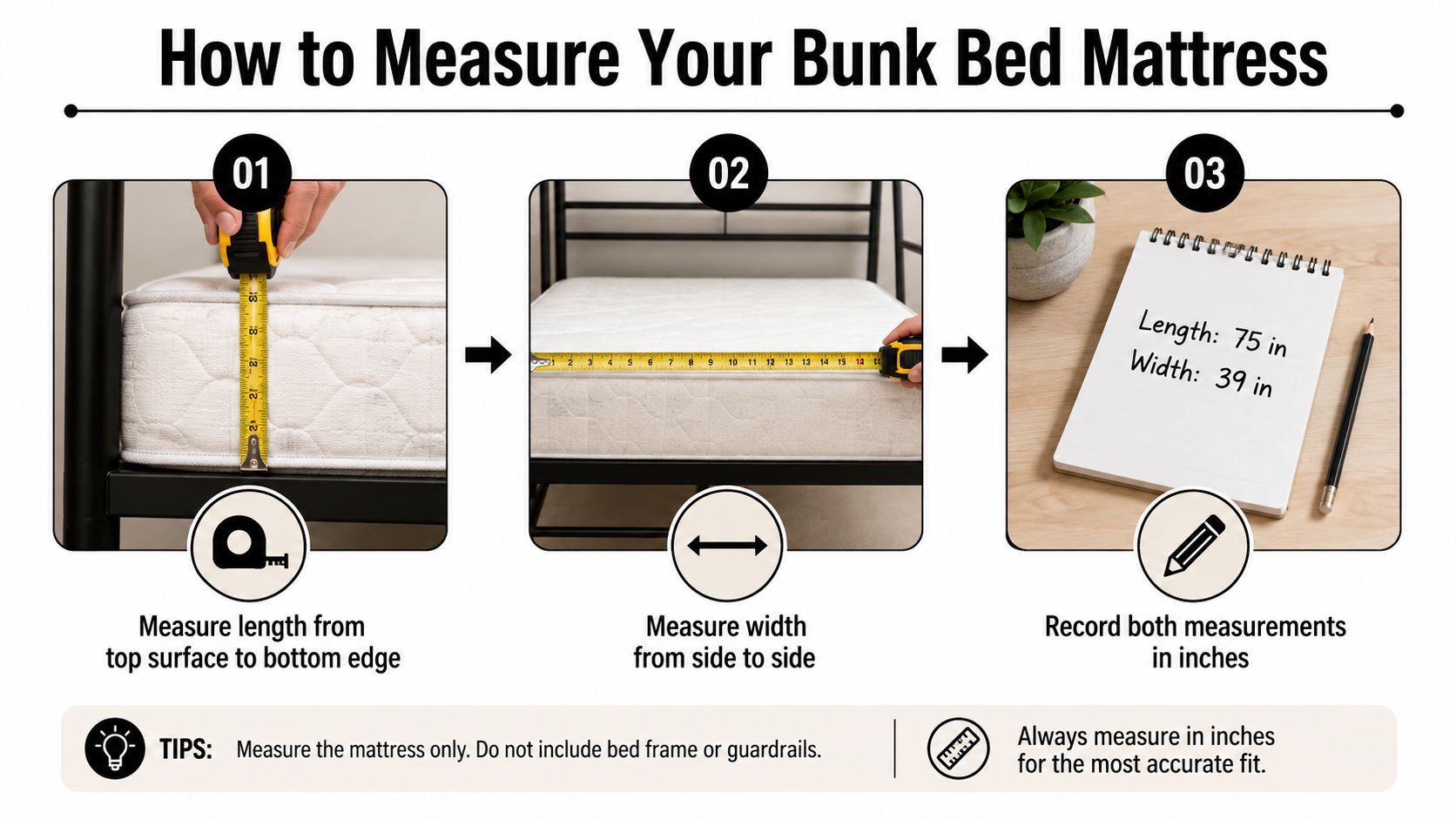
Measure the mattress itself—not the frame opening, rails, ladder, platform, or guardrail. A tape measure and a simple linen map for the property are enough.
- Measure the length. Measure from one end of the mattress to the other across the usable sleeping surface.
- Measure the width. Measure from side to side at the widest usable point. Do not include the surrounding structure.
- Measure the depth. Measure from the support surface to the top of the mattress. Include a permanently used topper.
- Record the location. Label each measurement by bed position, such as “upper left,” “upper Twin XL,” or “lower full.”
Measuring mistakes to avoid
- Do not use the platform or foundation height as mattress depth.
- Do not compress a soft mattress with the tape measure.
- Do not assume every bunk in a custom room is identical.
- Do not rely on a package label when the installed mattress is unusual.
For a single replacement, these measurements reduce the chance of ordering the wrong linen. For a complete bunk room, they create a repeatable record for future housekeeping and replacement orders.
Mattress Thickness, Guardrails, and Bunk Safety
Sheet depth is also connected to the overall bunk setup because the mattress surface determines guardrail clearance. The U.S. Consumer Product Safety Commission requires the top of the guardrail to be at least 5 inches above the surface of the thickest mattress recommended by the manufacturer.
Owners should follow the mattress thickness specified for the bunk system. A replacement mattress or permanent topper can raise the sleeping surface and reduce clearance. Guests may also bring additional bedding or toppers, so rental managers should make the intended mattress specifications clear.
CPSC requirements also address guardrails on elevated bunks, including the need for guardrails on both sides in applicable configurations. Review the bunk manufacturer’s instructions and applicable safety requirements rather than treating a deeper mattress as a minor comfort change.
Before changing mattresses or linens, check:
- The recommended mattress size and thickness for the bunk system.
- The complete height of the mattress and any permanent topper.
- The relationship between the mattress surface and the guardrails.
- Whether the fitted sheet stays flat without excessive material.
- Whether a new mattress model changes ladder access, headroom, or the intended sleeping position.
Choosing Linens for High-Traffic Coastal Rentals
Florida vacation-rental bunk rooms may experience frequent laundering, wet swimsuits, sand, sunscreen, active children, and full occupancy during peak travel periods. Choose sheets that work with the property’s actual laundry process and test one set on the mattress before outfitting every bunk.
- Consider the laundry cycle: Cotton percale offers a crisp feel, while some polyester blends may simplify laundering and reduce wrinkling.
- Standardize when possible: Matching mattress sizes make it easier for housekeeping to sort, install, and replace sheets.
- Label the inventory: Separate “Twin upper,” “Twin XL upper,” and “Full lower,” and keep the actual dimensions with the supply records.
- Keep backup sets: Additional inventory helps with back-to-back bookings and laundry delays.
- Replace early: Remove sheets when elastic weakens, corners stop staying flat, or seams begin to fray.
A written linen map is particularly useful when a property combines standard and custom bunks. It replaces guesswork with a consistent reset process.
Custom Bunk Beds and Nonstandard Mattresses
Some coastal properties need more than a standard twin-over-twin arrangement. Narrow RV-style mattresses, adult bunks, triple bunks, quad bunks, hallway bunks, and queen configurations can all require direct measurement and a specific linen plan.
Using a 38-inch twin sheet on a narrower mattress can leave excess fabric and weaken the tuck. Conversely, forcing a specialty mattress into a smaller sheet can stress the elastic and create a poor sleeping surface. Linens should follow the installed mattress dimensions.
When a bunk system is being planned, coordinating mattress size, guardrail placement, ladder access, headroom, cleaning access, and future sheet availability can prevent avoidable operational problems. This is valuable for beach houses, vacation condos, family homes, and hospitality properties throughout the Florida Gulf Coast region.
Florida Bunk Beds offers custom bunk-bed layouts for vacation properties and coastal homes. Browse the available designs, then call or text to discuss the room, mattress requirements, and quote options.
Frequently Asked Questions
What size sheets fit a standard bunk bed?
Most traditional bunk beds use standard twin mattresses measuring about 38 by 75 inches. Confirm the mattress dimensions before buying, especially in a custom or rental installation.
Do Twin XL sheets fit a regular twin bunk?
They may be too long and leave excess fabric. A regular twin mattress is typically 75 inches long, while a Twin XL is typically 80 inches. Match the fitted sheet to the actual mattress.
What pocket depth is best for a bunk mattress?
Measure the mattress and any permanent topper. Many low-profile bunk mattresses are approximately 6 to 8 inches thick, so a fitted sheet with a compatible pocket—often around 7 to 10 inches—may work, but the actual measurement should control.
Can I use the same sheets on a twin-over-full bunk?
No. The upper bunk normally uses a twin sheet and the lower bunk uses a full sheet. Keep the two sizes clearly separated in the property’s linen inventory.
How do I plan linens for a custom bunk room?
Measure every mattress, record each bed position, confirm pocket depth, and test-fit a set before purchasing the full inventory. If the bunks are not built yet, discuss mattress and linen requirements during the design process.
Can Florida Bunk Beds help with a vacation-rental bunk layout?
Yes. Browse the design catalog, then call or text Carson or Andy at 850-361-9988 to discuss your room and request a quote. Availability and design suitability depend on the specific project.
Start Your Bunk Bed Project
Whether you are furnishing a Gulf Coast vacation rental, updating a beach condo, or planning a family bunk room, start with the mattress dimensions and the way the room will be maintained between guests.
Browse designs, call or text Carson or Andy at 850-361-9988, and request a quote for your project.